Lamina Hybrid Engine
Validation Study v1.0
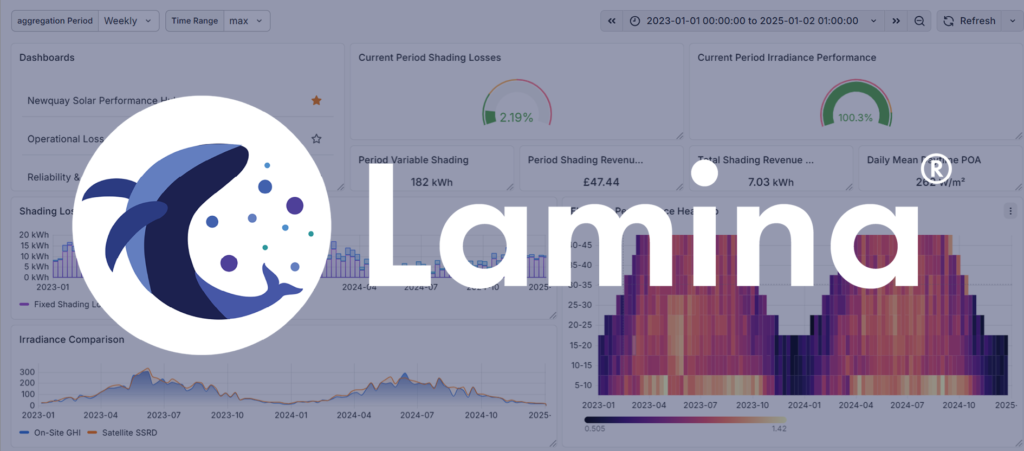
8-Year Longitudinal Validation | Coastal Reference Site
Standard monitoring systems see data; they don’t always see reality. To validate the Lamina Hybrid Engine, we partnered with Newquay Weather Station to benchmark our Physics-ML architecture against 2,742 days of high-fidelity telemetry. Situated in a harsh, variable coastal environment, the asset faced a perfect storm of yield killers: salt corrosion, high wind loads, and complex horizon shading.
Our Objective: To empirically verify the engine’s modelling fidelity, proving that physics-based rigor can convert underutilised telemetry into a high-confidence digital twin, unlocking actionable clarity and yield recovery opportunities.
The Investigation: Benchmarking v1.0 Fidelity
Validation of v1.0 focused on eliminating model drift by anchoring stochastic machine learning to deterministic physical laws. By processing 2,742 days of raw high-fidelity telemetry, we stress-tested the engine’s ability to maintain a precise performance signature during extreme coastal weather variance, complex shading scenarios, and iterative periods of component replacements and repowering.
8 Years of Raw Telemetry Data
5-Minute Resolution Analysis
Dual-Stream Data (Onsite + Satellite)
The Methodology
To ensure the Lamina Hybrid Engine provides a truly generalisable digital twin, we employed a 5-fold cross-validation protocol. By partitioning the dataset into multiple training and unseen testing subsets, we verified that the engine’s accuracy remains consistent across varying seasonal cycles, rather than over-fitting to specific historical anomalies.
The “blind testing” benchmarked the engine against two distinct operational scenarios: a “Golden” baseline of healthy performance and a “Full” dataset inclusive of all data points and site anomalies. This process confirms the engine’s capability to isolate non-linear fault signals with high statistical confidence, ensuring that maintenance resources are focused on actionable yield recovery rather than stochastic modelling artifacts.
98.7% Precision (R2) Digital Twin Calibration
We rigorously calibrated the model against operational data to establish a “Digital Twin” baseline. Under healthy operating conditions, the Lamina engine captures over 98% of performance variance, providing a robust benchmark. This granular precision enables forensic fault isolation, whilst the aggregated daily yield accuracy of > 99% confirms the model’s bankability for reporting.
Hybrid Accuracy: Physics + Machine Learning
Standard physics models often fail to capture the complexities of real-world performance. By supplementing physics expectations with machine learning, our engine adapts to site-specific characteristics, like horizon shading and thermal dissipation. The hybrid approach delivered a significant reduction of > 40% in residual error compared to standard physics-only models.
Sub-System Fault Isolation
The model validated its capability to act as an “Early Warning System” for asset health. By tracking rolling-volatility metrics, the analysis identified a statistically significant rise in inter-string instability (increasing from 0.03 to 0.05) in the years leading up to string failure and replacement, with instability returning to baseline post replacement. This confirms the engine’s potential to flag increasing degradation risks before catastrophic failure.
Validation Conclusion
The analysis confirms that the hybrid engine delivers a robust digital twin. Through a dual layer modelling approach, a granular decomposition of the performance gap was achieved, splitting unavoidable environmental factors from recoverable losses, and highlighting a potential 2-3% recoverable annual yield opportunity. Additionally the model proved capable of detecting early symptoms of accelerated degradation and provided a framework to validate OpEx ROI.
This study validates the framework’s potential to transition solar portfolios from passive, schedule based maintenance to active, data-driven interventions fueled by real-world performance signatures.
Yield Loss Decomposition
The analysis moved beyond standard Performance Ratios to decompose the total performance gap into specific component inhibitors. The model successfully separated unavoidable environmental losses from recoverable factors, explicitly quantifying distinct categories such as degradation (4.3%), inverter inefficiencies (3.2%), and variable shading (1.6%). This granular attribution enables the transition from broad performance monitoring to precise root-cause isolation, allowing for a rigorous cost-benefit analysis of technical interventions.
Sub-System Health
Beyond system-level averages, the analysis isolated granular hardware performance by identifying statistically divergent behaviour in String 2 compared to the array median. By tracking rolling-volatility metrics, the model flagged a significant rising trend in inter-string instability in the years preceding string failure, with metrics returning to baseline following panel replacement. This granular visibility enables the transition from broad, untargeted string testing to specific, evidence-based warranty monitoring before catastrophic failure.
OpEx ROI
The engine provides a rigorous framework for financial decision-making by quantifying the expected revenue impact of specific fault mechanisms and changes. By validating the statistical significance of losses (p < 0.05) and correlating results with weather effects and maintenance logs, the methodology effectively separates physical loss signals from sensor noise. This ensures that maintenance resources are deployed optimally toward interventions with a confirmed Return on Investment, supporting the strategic transition to Condition-Based Maintenance.
Commercial Outcome: Validating the Transition to Condition-Based Maintenance
This validation study provides a practical look at how high-fidelity modelling can be integrated into operational solar portfolios. By achieving 98.7% precision in the digital twin calibration and identifying 2-3% of annual yield recovery opportunities, at our reference site, the analysis highlights the potential for forensic rigor to support more informed financial decisions. Moving toward a Condition-Based Maintenance strategy offers a path to better manage O&M costs and protect long-term asset health and ROI using real-world performance data.
Start the Conversation
Unlock the clarity hidden within your portfolio
We are the right partner for you if...
- You manage renewable energy assets worth protecting
- You prioritise true insight over standard reporting
- You value engineering precision in performance analysis
- You are ready to turn uncertainty into quantified opportunities
Discover what your data is hiding
Email us
contact@lamina-ai.co.uk